You are welcome to post questions in the thread later, and Silona will do her best to answer them when she has the time. We will close the thread after a couple of days – though of course the door remains open to chat with the MetaBrainz team any time in the future!
The Picard team is happy to announce the new major version 3.0 of MusicBrainz Picard, now available to download. MusicBrainz Picard is the official tag editor for the MusicBrainz database and helps you get your music collection sorted and cleaned up with data from MusicBrainz.
This release brings many changes, including an upgrade to Qt6, a completely new plugin system, several improvements to the user interface, cover art processing, ISRC submission and many more. More details below.
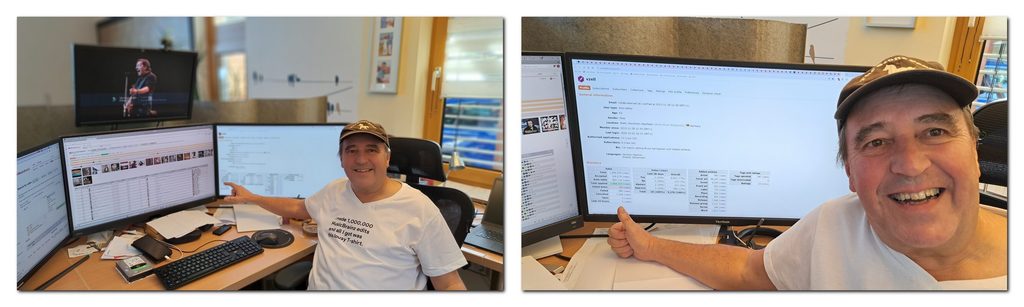
These users have donated substantial amounts of their time to improve open music data, enriching open-source knowledge and culture for billions of people. Let’s find out what makes vzell click. And click and click and click!
Hi everyone, I’m Sreehari, also known online as owlpharoah (op3kay on Matrix). I’m a second year student at IIIT Jabalpur. This summer I worked on the foundations of a GraphQL server in Rust that sits over the MusicBrainz PostgreSQL database, under the guidance of @bitmap and @jadedblueeyes.
The Setting
MusicBrainz already has an XML/JSON API, but getting related data out of it means chaining together inc parameters, and browsing support differs from one entity type to the next. Looking up five artists at once isn’t really possible either.
GraphQL fixes most of this by letting a client ask for exactly the fields and relationships it wants in one query. It also lets the server check how expensive a query is before running it, instead of finding out after the database has already taken the hit.
Before writing the proposal, I built a rough prototype covering Artist, Release Group, Release, and Recording, mainly to see how things would click together. Two problems showed up: N+1 queries on relationship fields, and the fact that depth limiting alone doesn’t catch a shallow query that’s still expensive. Both became core parts of the proposal.
The Plan
The proposal scoped the project to six entity types: Artist, Release Group, Release, Recording, Label, and Area. Each would be queryable by MBID, with the usual relationships between them, plus aliases, tags, genres, and ratings across the board.
A few decisions were made initially:
DataLoaders would follow a two tier split. One loader maps an entity’s internal id to the hydrated entity itself and gets reused everywhere that entity shows up. A separate, thinner loader maps a parent id to a list of child ids.
Fields that need a loader call would live behind ComplexObject, so they only run when a client actually asks for them.
Pagination would use keyset pagination instead of offset pagination, since offset pagination gets slow and inconsistent on large tables that change often.
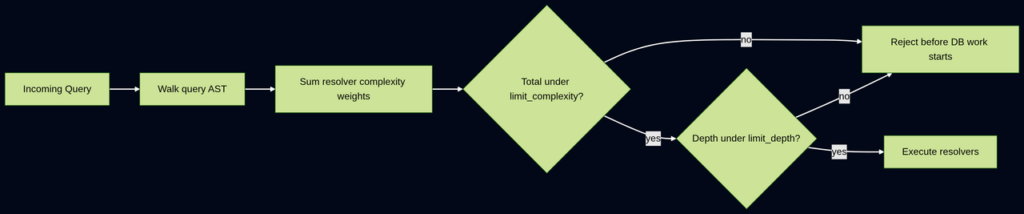
Query safety would come from depth limiting plus a complexity weight on every resolver.
key goals
A working GraphQL server covering the six entity types
Schema level depth limiting and query cost analysis
A performance baseline from load testing.
The Result
DataLoader infrastructure is in place across all six entities, following the two tier split. Loaders exist for tags, ratings, artist credit, genres, annotations, aliases, ISNI and IPI identifiers, and MBID to internal id resolution. Hydration loaders are shared across every relationship that points at a given entity instead of duplicated per relationship.
MBID redirect handling lives inside each loader’s load function. When a primary table lookup misses, the unresolved MBIDs get batch queried against the matching *_gid_redirect table, and any hits get merged into the result map. A resolver further up never has to know a redirect happened.
Keyset pagination runs across the paginated fields using ROW_NUMBER() OVER (PARTITION BY parent_id ORDER BY child_id) in a single batched query, so one query can apply a per parent limit across a whole batch of parents. The cursor ended up as a plain integer rather than the opaque string from the proposal.
Query complexity weights reflect actual database work: a scalar field costs its default, a single hop DataLoader field costs a flat amount, a paginated one to many field scales with the requested page size, and multi hop fields carry a multiplier on top.
Integration tests cover all six entities.
Week 7’s load testing with k6 turned up two findings worth fixing. There was an N+1 on the isrc field, fixed with a dedicated RecordingIsrcLoader, and a gap in the complexity limiter where a pathological query executed instead of getting rejected outright.
On the infrastructure side, CI runs pre commit hooks and no longer has dead code warnings, and documentation is wired up through Magidoc in Docker compose.
What I Learned
The two tier loader split sounded simple on paper, but it’s saved me a lot of time in practice. Adding a new relationship is now mostly copying hydration logic that already works, instead of writing it fresh.
Fixture data needs to be checked against the database it’s running against, not assumed to be stable. musicbrainz-docker’s sample dumps import non-deterministic subsets of the data, so an MBID that resolves cleanly on my machine can point at something else, or nothing, on someone else’s. That cost me a few confused debugging sessions before I figured out what was going on.
What’s Next
Criterion benchmarking, to compare the current per row queries on ComplexObject fields like Release.date against a batched loader variant, and to compare the two hop ArtistCredit and Tags loader patterns against a single joined loader.
Moka caching is still an open evaluation.
Extended entity coverage beyond the original six.
Conclusion
This was an awesome summer and i enjoyed thinking about and wiring up the API schema and the Postgresql database, fixing bugs, and everything in between. It was really satisfying watching the two tier loader pattern click into place once and then just work for every relationship added after it.
Thanks to my mentors for the guidance, especially on the DataLoader architecture, which I wouldn’t have landed on alone. And thanks to the wider MetaBrainz community for the space to build this in. It’s been a pretty nice summer of query plans, a lot of Rust, and debugging, and I’d do it again.
We received good feedback on the previous release candidate 3, which resulted in several bugfixes and small improvements. The Picard team hence decided to release a fourth release candidate in preparation for the final release of Picard 3.0.
It fixes an important performance issue, so if you are currently running any of previous alpha, beta or release candidate versions upgrade ASAP. It also fixes issues related to internationalization, causing some of existing translations to not actually show in the application (mainly constants).
Please test, test, and test, report any issue on forums, matrix, or, ideally, on the ticket system. When reporting an issue, always provide details about your environment and a full debug log helps us a lot. Also now is a good time for final review and improvements of the translations.
Download links and a detailed list of changes since Picard 3 release candidate 3 are available below. For a more detailed overview of what is new in Picard 3 please see the previous blog post Picard 3 Alpha Release.
While we have all the major features implemented and with the latest bug fixes we are confident in the current code, this is still a pre-release and there might be bugs. If you use this, do so with care, backup your files and please report any issues you encounter.
If you are updating from Picard 2, note that some of the changes are backward incompatible, hence we recommend you make a backup of your Picard.ini config file before trying this version. You can do so in Picard’s Options under Advanced > Maintenance.
We are very pleased to announce that the MetaBrainz Foundation has appointed Silona Bonewald as Executive Director, following the unfortunate passing of our Rob at the beginning of the year.
Silona has served as Executive Director of IEEE SA Open and Vice President of Community Architecture at Hyperledger, part of the Linux Foundation. Earlier in her career she served as Director of InnerSource at PayPal and authored the widely used O’Reilly publication Understanding the InnerSource Checklist.
Silona also founded the League of Technical Voters, a 501(c)(3) organization dedicated to government transparency through open source technology, and has since advised nonprofit and open source organizations including the Cardano community’s IntersectMBO, the Foundation for Public Code, and the Software Freedom Conservancy. She has served on the board of the Electronic Frontier Foundation’s Austin chapter in the past and holds standing relationships across the world wide standards communities, and more… If you would like to keep browsing Silona’s looong list of professional credentials you are welcome to follow her on LinkedIn.
That’s all a long way to say that we are very excited to have Silona on board! The team is looking forward to working with Silona and you (our wonderful community) to carry Rob’s legacy forward.
Please give Silona a warm welcome in the comments!
Silona will also be hosting an AMA on 5 October 2026, at 17:00 UTC, on the forums (we will do another announcement regarding this, closer to the time), where you can post questions and share with Silona some of your dreams for the future of the MetaBrainz Foundation and its projects!
Today the Picard team is making available a third release candidate for Picard 3. We received good feedback on the previous release candidate 2, thanks to everyone for testing and providing feedback. The final 3.0 release is planned to happen in a few weeks.
When reporting an issue, always provide details about your environment and a full debug log helps us a lot. Also that’s (always) a good time to review and improve translations.
Download links and a detailed list of changes since Picard 3 release candidate 2 are available below. For a more detailed overview of what is new in Picard 3 please see the previous blog post Picard 3 Alpha Release.
While we have all the major features implemented and with the latest bug fixes we are confident in the current code, this is still a pre-release and there might be bugs. If you use this, do so with care, backup your files and please report any issues you encounter.
If you are updating from Picard 2, note that some of the changes are backward incompatible, hence we recommend you make a backup of your Picard.ini config file before trying this version. You can do so in Picard’s Options under Advanced > Maintenance.
Today the Picard team is making available a second release candidate for Picard 3. We received good feedback on the previous release candidate 1, thanks to everyone for testing and providing feedback. The final 3.0 release is planned to happen in a few weeks.
Download links and a detailed list of changes since Picard 3 release candidate 1 are available below. For a more detailed overview of what is new in Picard 3 please see the previous blog post Picard 3 Alpha Release.
While we have all the major features implemented and with the latest bug fixes we are confident in the current code, this is still a pre-release and there might be bugs. If you use this, do so with care, backup your files and please report any issues you encounter.
If you are updating from Picard 2, note that some of the changes are backward incompatible, hence we recommend you make a backup of your Picard.ini config file before trying this version. You can do so in Picard’s Options under Advanced > Maintenance.
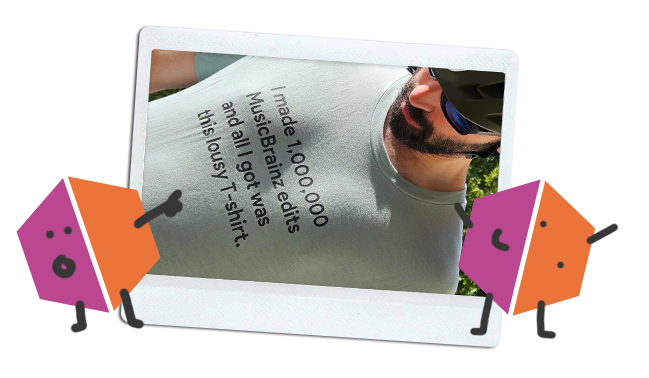
Editors are by far MetaBrainz’ biggest and most irreplaceable resource.
They (you) spend countless hours entering data for free, be it for the love of music, to tidy their own collections and listen histories, to support their scenes, to archive historical and cultural data, to apply the cool and soothing editing brain-balm, or a combination of all of the above and more.
Some of the top editors have provided the backbone of MusicBrainz for years, decades, and often perform the more tedious data maintenance and checking tasks.
A few summits ago, the question was asked – can we give these editors, say those with 1 million+ edits, some recognition without getting into the quagmire of things like gamifying?
The Picard team is excited to announce the first release candidate for Picard 3. With this release we are confident that Picard 3 is now suitable for testing by a wider audience. The final 3.0 release is planned to happen in a few weeks.
Since we are near a final release, we tried to focus on bugfixes, final changes to the Plugin API and further UI/UX improvements. On the UI side, Picard now fully supports dark / light mode across all supported operating systems, with the ability to change the theme without a restart.
Download links and a detailed list of changes since Picard 3 beta 9 are available below. For a more detailed overview of what is new in Picard 3 please see the previous blog post Picard 3 Alpha Release.
While we have all the major features implemented and with the latest bug fixes we are confident in the current code, this is still a pre-release and there might be bugs. If you use this, do so with care, backup your files and please report any issues you encounter.
If you are updating from Picard 2, note that some of the changes are backward incompatible, hence we recommend you make a backup of your Picard.ini config file before trying this version. You can do so in Picard’s Options under Advanced > Maintenance.