Over the past few weeks I’ve received a number of emails from people who are concerned about some editors who are losing sight of some basic principles behind editing data in MusicBrainz. I wanted to chime in and remind people of some of the principles that should guide how we all get along when we edit data in MusicBrainz.
First and foremost is:
Be polite and give people the benefit of the doubt that they are doing the right thing.
I don’t have to explain being polite. Yes, we all have our bad days — that is a given. But if you’re having a bad day, stop editing MusicBrainz and step away from your computer. Go outside! When you do edit, please be kind to your fellow editors.
Giving people the benefit of the doubt that they are doing the right thing is also important. The vast majority of people who edit MusicBrainz have good intentions and you should assume that to be the case.
Second, edit to make the database better. Vote yes if an edit makes the data better.
This one is a lot more vague, since “better” is a subjective term. We should accept edits that are “good enough” and avoid asking people to make “perfect” edits.
Edits fit into four categories:
Edits that makes things better (perfect or not)
Edits makes things different (but neither are better)
Edits that contain some correct things and some incorrect things
Edits that are outright wrong (existing data is better)
The first type should clearly get a yes vote. For the second, if it doesn’t make things worse, abstain and leave a comment. The third is a judgement call and I would suggest applying this heuristic:
Unless it takes more time to fix the edit than to make a new one, vote yes.
Clearly, the fourth type deserves a no vote.
That brings me to the final topic for now: No votes. A no vote is a very strong expression that has potentially chilling effects that may prevent people from editing again. A no vote should be considered the last resort. Use a no vote if you can’t find another way to resolve an edit.
Finally, some tips for auto editors: If you see an edit that is not perfect, approve it and fix it.
Auto editors are supposed to set the tone for the project and auto editors should practically never vote no on something. You have more powers than fellow editors, so please use your powers for good!
Picard 1.3.2 is now available on the Picard download page. This again is only a small maintenance release which mainly updates the OS X build to fix crashes some users experienced with Picard 1.3.1. Here is the complete list of fixes:
Bug
[PICARD-681] Fixed tags from filename dialog not opening on new installations
This release is quite small because it overlapped with the holidays, but contains a fix for an annoying guess-case issue in the release editor that several people reported. Thanks to chirlu for the rest of the bug fixes listed here!
The git tag is v-2014-12-29.
Bug
[MBS-4668] – Edit search loses selections when the page number is too high
[MBS-8064] – Can’t add documentation to migration-created relationship types
[MBS-8086] – Guess case for release title does not trigger an edit
[MBS-8091] – Can’t fix non-normalized artist credits
We’ve released another server update today, though a fairly modest one, since bigger changes have been happening in the background with embedding JSON-LD into our pages and switching our JavaScript over to browserify. A few more edit types have been made auto-edits for everyone, as detailed in the changelog below. There’s additionally been some misc. UI changes, and a fix to output artist genders in the JSON webservice.
Thanks to chirlu, nikki, reosarevok, and the MetaBrainz team for their hard work on today’s release.
The git tag is v-2014-12-15.
Bug
[MBS-7916] – “Set track durations” preview is broken for single-track mediums
[MBS-8008] – “Add Event” (entity) and “Add Event” (release event) share the same translation string
[MBS-8044] – Map doesn’t zoom when pasting coordinates
[MBS-8066] – “Date” field wraps inconsistently in different browsers
[MBS-8082] – Gender missing on artist lookup (JSON)
Improvement
[MBS-7478] – Make more use of HTML5 form field types
[MBS-7970] – Replace guess case bubbles with icons next to the fields
[MBS-7973] – Make remove alias/ISRC/ISWC edits auto-edits for auto-editors
This Friday we’re going to need to take a 15-20 minute downtime to fix a few leftover issues from our recent schema change. We tried to do this without downtime, but the service got progressively slower, so we’re electing to take some downtime.
After skipping a fortnight because of concentrating on the schema change release, here’s the next edition of the style update, with all the changes from the last month. Most of the changes involve adding new medium formats and new place/area relationships, plus making changes and additions related to the new schema change features (events and data tracks).
The biggest change this month is the addition of a classical music titles guideline. This deprecates the old Opera Tracks guideline, and basically just provides a certain amount of standardisation while keeping mostly true to the on-cover titles.
A day late, but hopefully no dollars short, we’re back with another release. This release is mostly bug fixes, as you’d expect right after a schema change release. nikki has done some work with our CSS, however, and chirlu did some work updating and clarifying our INSTALL.md. Thanks to them, mineo, and the MetaBrainz team for their work this release!
The git tag for this release is v-2014-12-01.
The usual list of bugs fixed:
Bug
[MBS-4232] – Edit artist shows artists credits section when it doesn’t apply
[MBS-4622] – Improve handling of cover art when JS is off
[MBS-6971] – No controls for uploading cover artwork in IE8
[MBS-7497] – cpanm install fails with Can’t locate File/Copy/Recursive.pm in @INC
[MBS-7952] – Release editor does not handle removed mediums correctly when reordering mediums
[MBS-7988] – Adding a pregap track to an existing tracklist and it shows as a data track
[MBS-7992] – Data track option doesn’t behave properly with disc IDs
[MBS-7993] – Edit medium edits for pre-gap tracks claim to change data tracks
[MBS-7995] – DBDefs.pm.sample is still at schema version 20
This upgrade shouldn’t be substantially different than past upgrades, now that we’ve fixed a few bugs with the process. To upgrade:
Make sure your REPLICATION_TYPE setting is RT_SLAVE and your DB_SCHEMA_SEQUENCE is set to 20 in lib/DBDefs.pm.
Ensure you’ve replicated up to the most recent replication packet available with the old schema. (if you’re not sure, run ./admin/replication/LoadReplicationChanges and see what it tells you).
Take down the web server running MusicBrainz, if you’re running a web server.
Turn off cron jobs if you are automatically updating the database via cron jobs.
Switch to the new code with git fetch origin followed by git checkout schema-change-20-to-21
Run ./upgrade.sh (or carton exec -Ilib -- ./upgrade.sh if you’re using carton, with very old setups).
Set DB_SCHEMA_SEQUENCE to 21 in lib/DBDefs.pm
Turn cron jobs back on, if needed.
Restart the MusicBrainz web server, if applicable. It’s also recommended you restart memcached.
That’s it! The only real difference from the past is the specific tag to be used: schema-change-20-to-21, which is a couple of fix-up commits past the regular release tag.
Hot on the heels of our release of the first 650,000 feature files as part of the first release of AcousticBrainz, we are presenting some initial findings based on this dataset.
We thank Emilia Gómez (@emiliagogu), an Associate Professor and Senior Researcher at the Music Technology Group at Universitat Pompeu Fabra for doing this analysis and sharing her results with us. All of these results are based on data automatically computed by our Essentia audio analysis system. Nothing was decided by people. Isn’t that cool?
The MTG recently started the AcousticBrainz http://acousticbrainz.org/ project, in collaboration with MusicBrainz. Data collection started on September 10th, 2014, and since then a total of 656,471 tracks (488,658 unique ones) have been described with essentia. I have been working for a while with audio descriptors and I followed the porting some of my algorithms to essentia, especially chroma features and key estimation. For that reason, I was curious to get a look this data. I present here some basic statistics. I computed them with the SPSS statistical software.
WHICH KIND OF MUSICAL GENRES DO WE HAVE IN THE COLLECTION?
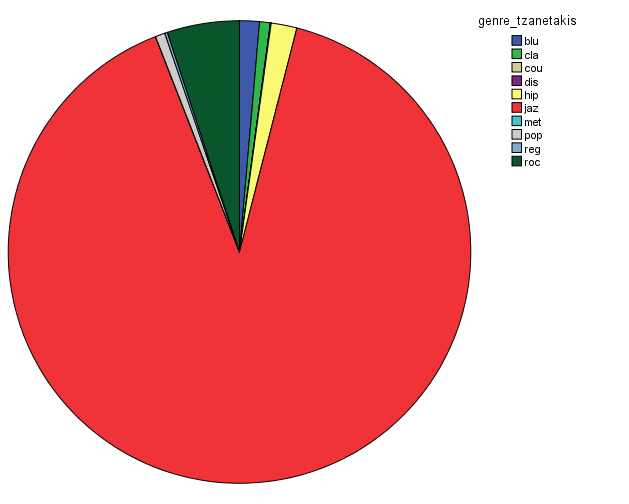
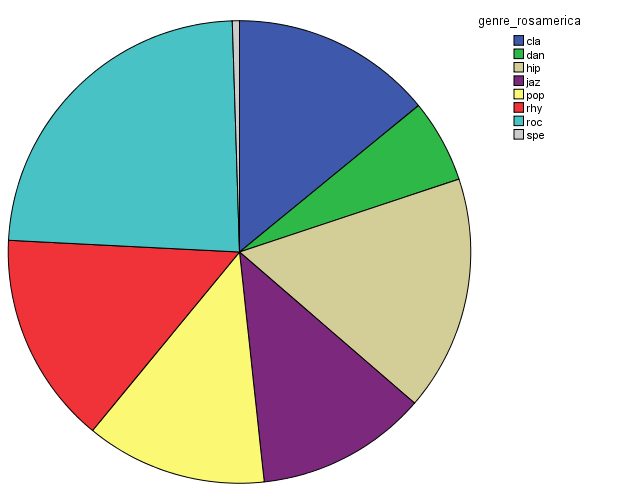
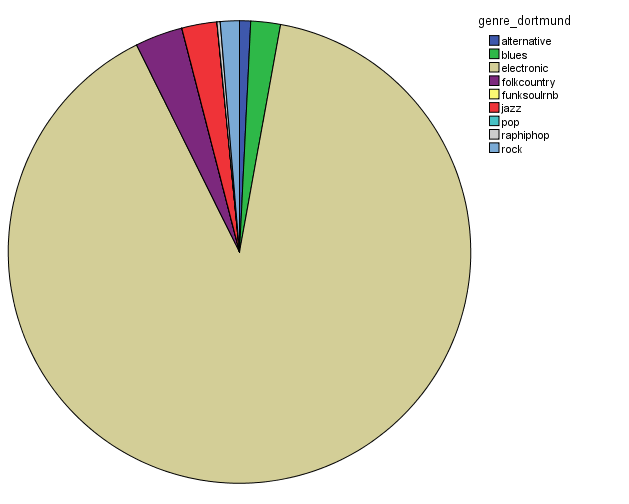
In order to characterize this dataset, I first thought about genre. In essentia, there are four different genre models: trained on the data by Tzanetakis (2001), another one compiled at the MTG (Rosamerica), Dortmund and a database of Electronic music. Far from providing information on the kind of musical genres, these models seem to be contradictory! For example, in the Tzanetakis dataset “jazz” seems to be the most estimated genre, while the proportion of jazz excerpts is very small in the other models.
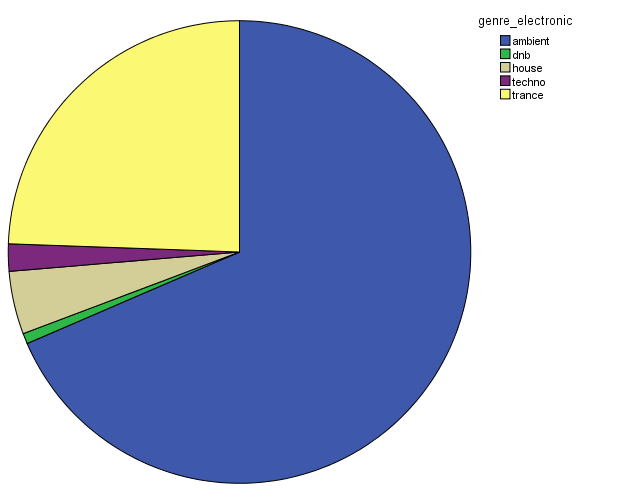
Genre estimations using the Tzanetakis datasetGenre estimations using the Rosamerica datasetGenre estimations using the Dortmund datasetGenre estimations using the Electronic dataset
So in conclusion, we have a lot of jazz (according to the Tzanetakis dataset), electronic music (according to the Dortmund dataset), ambient (according to electronic dataset) and an equal distribution of all generes Rosamerica dataset (which does not include a category for electronic music)….Not very clarifying then! This is definitely something that we will be looking at in more depth.
WHAT ABOUT MOOD THEN?
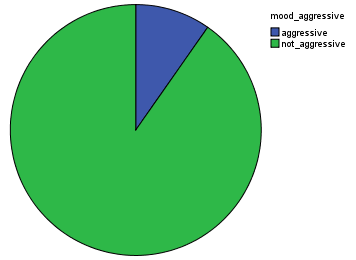
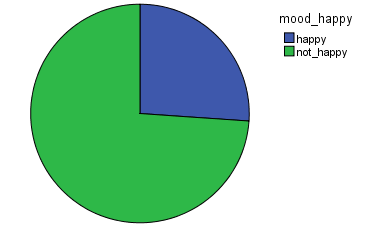
For Mood characterization, 5 different binary models were trained and computed on the dataset. We observe that there is a larger proportion of non-acoustic music, non-aggressive, and electronic. It is nice to see that most of the music is not happy and not sad! From this and previous study, I would then conclude that there is a tendency in the AcousticBrazinz dataset for electronic music.
Distribution of accoustic and non-accoustic (e.g. electronic) musicHow aggressive our dataset is
The amount of electronic music (compare with the acoustic graph above)
…and if the music is happy or not
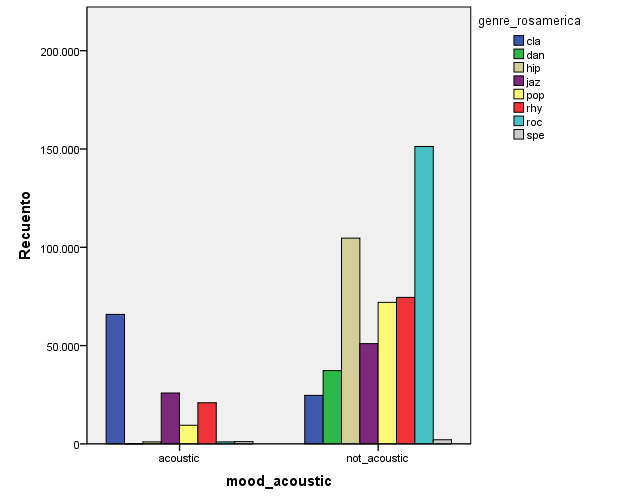
If we check for genre vs mood interactions, there are some interesting findings. We find that Classical is the most acoustic genre and rock is the least acoustic genre (due to its inclusion of electronic instruments):
How much music in each genre is accoustic or not
HOW IS KEY ESTIMATION WORKING?
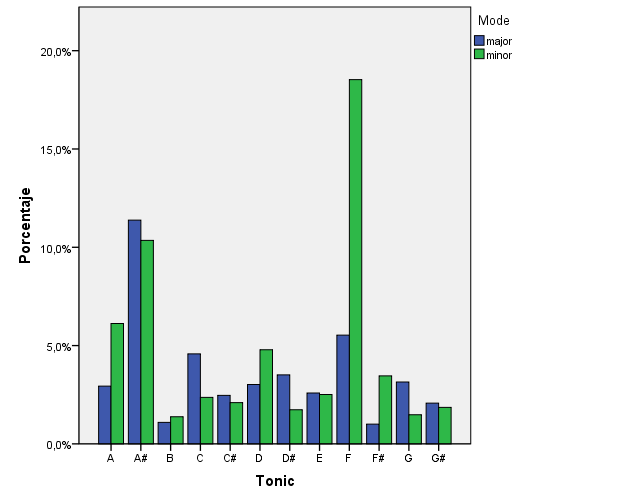
From a global statistical analysis, we observe that major and minor modes are both represented, and that the most frequent key is F minor / Ab Major or F# minor / A Major. This seems a little strange; A major and E major are very frequent keys in rock music. Maybe there are some issues with this data that need to be looked at.
The keys and modes of the tracks in the database
IS THERE A LINK BETWEEN FEATURES AND GENRE?
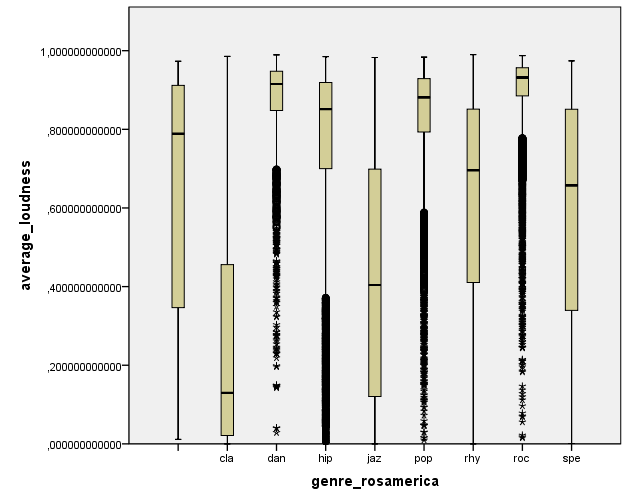
I wanted to do some plots on acoustic features vs genres. For example, we observe a small loudness level for classical (cla) music and jazz (jaz), and a high one for dance (dan), hip hop (hip), pop, and rock (roc).
The loudness of songs by genre
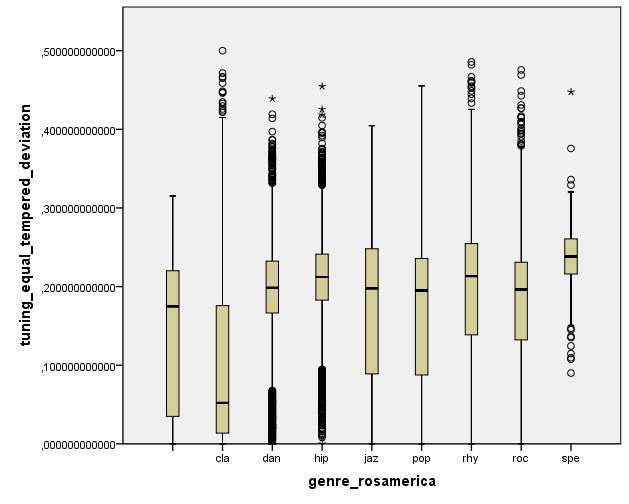
Finally, it is nice to see the relation between equal-tempered deviation and musical genre. This descriptor measures the deviation of spectral peaks with respect to equal-tempered tuning. It’s a very low-level feature but it seems to be related to genre. It is lower for classical music than for other musical genres.
Variation from equal‐tempered tuning per genre
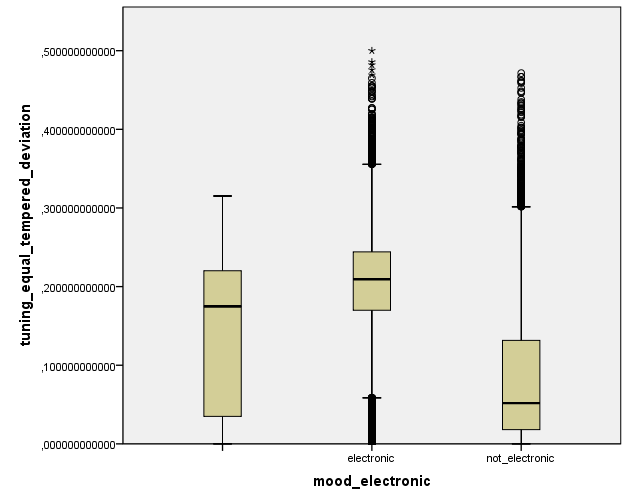
We also observe that for electronic music, equal tempered deviation is higher than for non-electronic music/acoustic music. What does this mean? In simple terms, it seems that electronic music tends to ignore the rules of what it means to be “in tune” more than what we might term “more traditional” music.
Variation from equal‐tempered tuning for songs reported as electronic/non-electronic
IS THERE A LINK BETWEEN FEATURES AND YEAR?
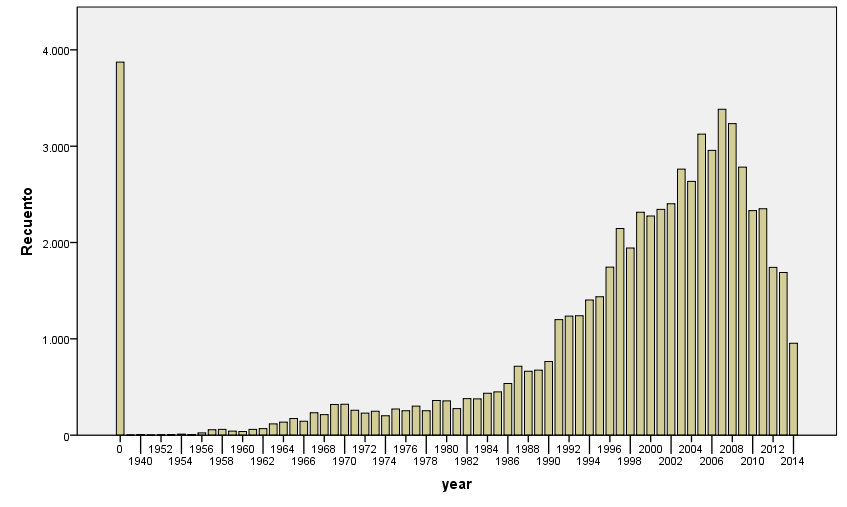
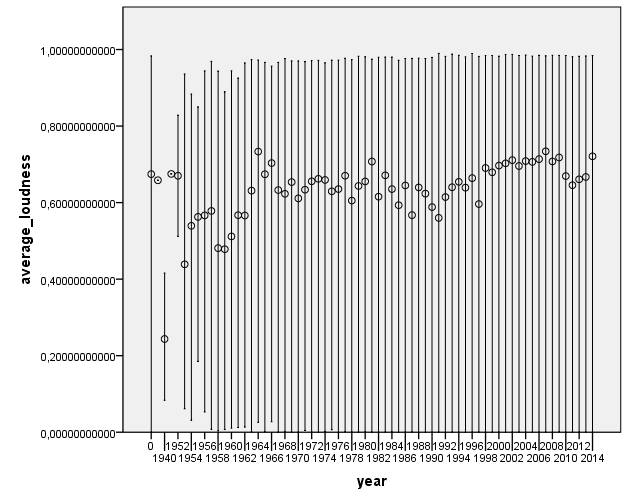
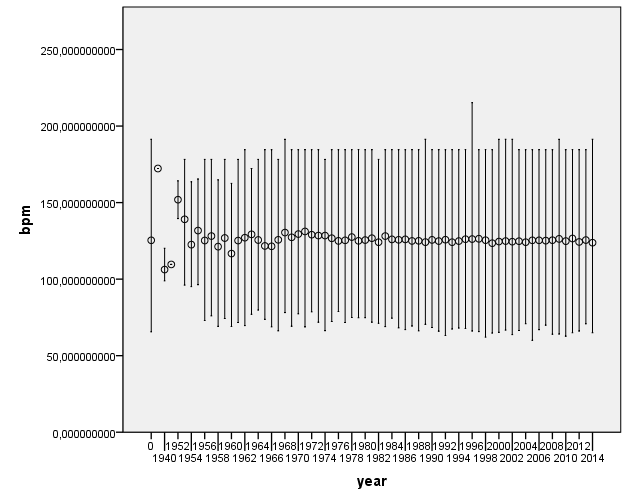
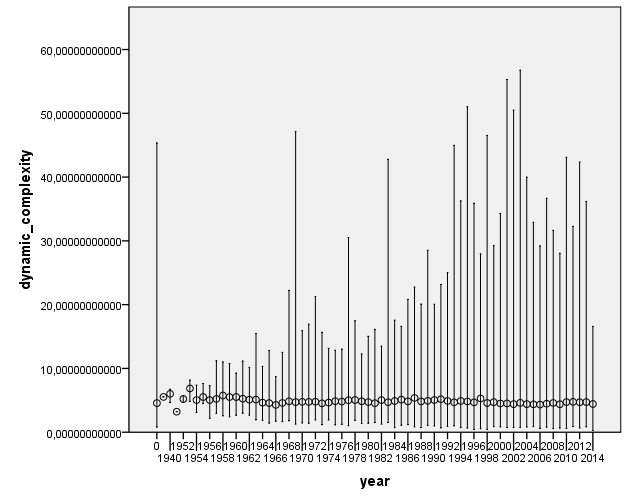
I was curious to check for historical evolution in some acoustic features. Here are some nice plots on the evolution of number of pieces per year, and some of the most relevant acoustic features. We first observe that most of the pieces belong to the period from 1990’s to nowadays. This may be an artifact of the people who have submitted data to AcousticBrainz, and also of the data that we find in MusicBrainz. We hope that this distribution will spread out as we get more and more tracks.
Distribution of release year for the dataset. 0 represents an unknown year
There does not seem to be a large change of acoustic features as year changes. This is definitely something to look into further to see if any of the changes are statistically significant.
Are the loudness wars true? Can you see a trend?Is music getting faster? It doesn’t look like itSongs aren’t geting more complex
We have many more ideas of ways to look at this data, and hope that it will show us some interesting things that we may not have guessed from just listening to it. If you would like to see any other statistics, please let us know! You can download the whole dataset to perform your own analysis at http://acousticbrainz.org/download