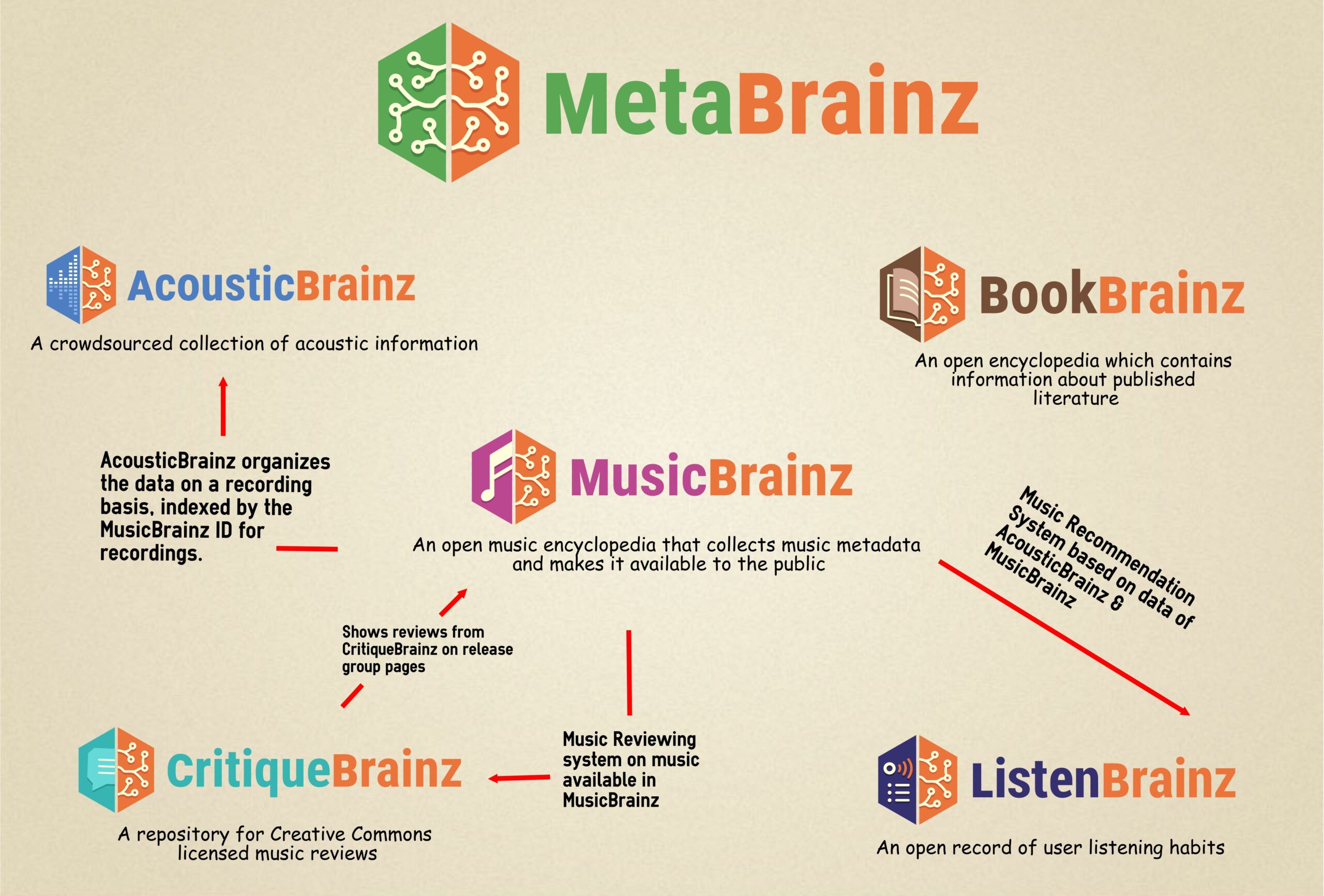
MetaBrainz has been accepted to Summer of Code 2017!

I’m pleased to announce that MetaBrainz has been accepted into the Google Summer of Code program for 2017!

If you are an eligible university student who would like to participate in Summer of Code and get paid to hack on a MetaBrainz project over the summer, take a look at our ideas page for 2017. If this sounds interesting, take a look at our getting started page.

We kindly ask that you carefully read the ideas page and the getting started page before you contact us for help!

Thanks and good luck applying!

Wrapping up Google Code‐in 2016

As Google has now announced the finalists of this round of Google Code-in, it feels only right that we also take a look back at what’s been taking up a large chunk of our time the last couple of months.

Divya Prakash Mittal (India – returning from last year!), Daniel Theis (Germany), and Tigran Kostandyan (Russia) all made it to the finalists, with Anshuman Agarwal (India) and Daniel Hsing (Hong Kong) additionally taking home the Grand Prize Winner positions! Congratulations to all of you and thank you so much for your contributions this year. 🙂 Continue reading “Wrapping up Google Code‐in 2016”

GSoC ’16 + ListenBrainz = fun :)

Hello,

I am Pinkesh Badjatiya and I have been working on ListenBrainz as part of GSoC ’16. I was largely involved in implementing the most requested features in ListenBrainz.
I began my journey with MetaBrainz not long before the Final Organization list was out. I started with MusicBrainz but moved quickly to ListenBrainz, and have been working on it since then.

About the project

The project consisted of creating a proxy scrobbling API similar to last.fm’s which could be used by existing desktop clients to submit listens to listenbrainz.org. I submitted my initial idea, that involved creating a new API along with few other optional features that were very much required (import, export, etc.).
The project made its way through the approval process, and I worked with ruaok (my mentor) & alastairp to get important things done. Yey!

Here are some of the snapshots of the my journey with ListenBrainz.

API_compat

ListenBrainz already had its own API which can be used to fetch/submit listens but all the existing clients that support scrobbling to last.fm use the ws.audioscrobbler.com’s API. To add support for these clients, I ended up creating a proxy API, api_compat (as in “compatible API”), that translates every request that is sent to “api.listenbrainz.org/2.0/” in the native format. This is an additional API which can be used along with the existing native ListenBrainz’s API.

This was largely the main goal of my project proposal. The instructions for scrobbling using Audacious are attached along with the source code.

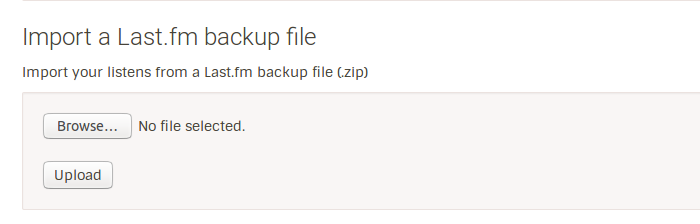
Import lastfm-backup

The import page now allows users to import listens from the last.fm scrobbles or from the backup file which was downloaded from the older version of the last.fm website.
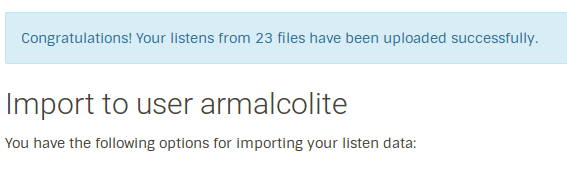
import_backup On successful import of listens from backup, you’ll get the following notification.import_success
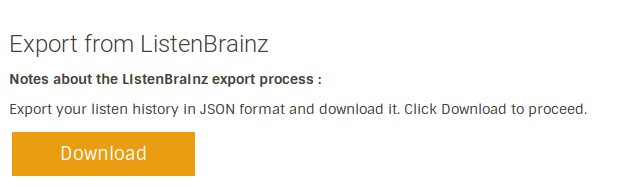
Export listens

This allows users to export the listens from the listenbrainz.org website. This is useful for users who want to keep track of their listen history offline as well.
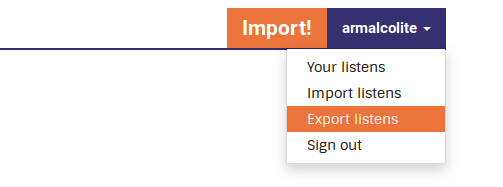
The export feature can be accessed from the drop-down menu.

export_dropdown_menuexport_page

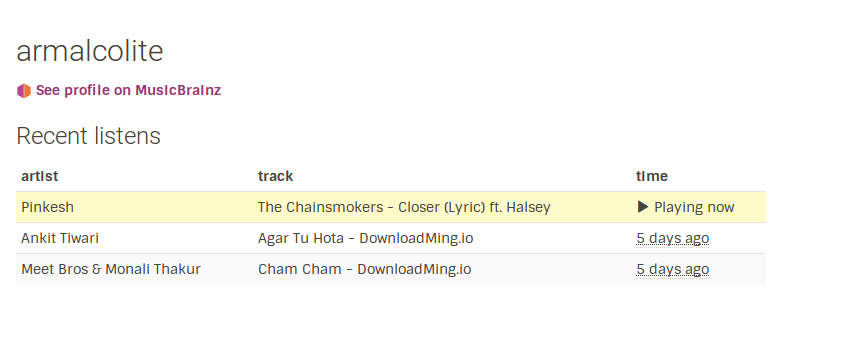
Playing Now

With the support for API-Compat, the support for currently playing song was needed. This keeps the currently playing song on the website in sync with your favourite player.
playing_now

Import scraper uses audioscrobbler API

I also worked on updating the import scraper which now use the ws.audioscrobbler.com‘s API allowing users to import without opening their last.fm profiles. This also provides other useful track information to ListenBrainz.

Migrate to PostgreSQL

Another important change to ListenBrainz was how it stored listens. We moved from using Cassandra to PostgreSQL. Cassandra was fast and effective but getting more information other than the user’s listens (ex. generating statistics) was not possible. So we switched to Postgres + Redis. This opened more possibilities for future.

Experience

After 3.5 months, I ended up with 15 merged and 3 closed PR’s and a bunch of features for ListenBrainz that improved its look and feel.

My pull requests: https://github.com/metabrainz/listenbrainz-server/pulls?utf8=%E2%9C%93&q=is%3Apr%20author%3Apinkeshbadjatiya%20

I have worked on quite a lot of varied things in the past 4 months. A lot of them were actually not the part of the GSoC proposal but they were done largely in the same timeline or were optional targets, so I suppose they would count significantly towards GSoC.
I worked largely with alastairp, ruaok and Gentlecat. Gentlecat helped improve my coding style by providing feedback on my PR’s. I worked with alastairp and ruaok regarding the ideas/suggestions on how to address a problem and its possible solutions. It was a interesting experience working with the community and getting to know about MetaBrainz. Now that my understanding of the project and the community has increased, I look forward to making some great contributions!

Conclusion

In short, ListenBrainz went through a hell lot of changes in the past 4 months. If you were waiting for it to improve before using it, then now is the time that you should try it. I bet you’ll love its new look and you won’t be disappointed. 😀

Summer of Code ’16 with Picard

Hi! I’m Rahul Raturi, GSoC participant for Picard. This was my first GSoC, and it’s been a pretty awesome experience. Following is the overview of my project.

About the project

The outline of the project is to allow searching for albums, artists and tracks from within Picard. This avoids switching back and forth between web browser and Picard for searching, say release. If Picard fails to auto tag a file usual flow to tag the file with correct metadata is to first select the file, then click on “Lookup in Browser”, then search correct release, and load it into Picard by clicking the green “Tagger” button. In some systems, the “Tagger” button wouldn’t show, which was also a nuisance. With this patch, the entities can be searched and optionally loaded into Picard using built-in search dialogs, so no application switching.

Search dialogs

Picard already provides search options (through a web browser) for three entities; namely track, artist, and album. So I’ve built search dialogs for these three.

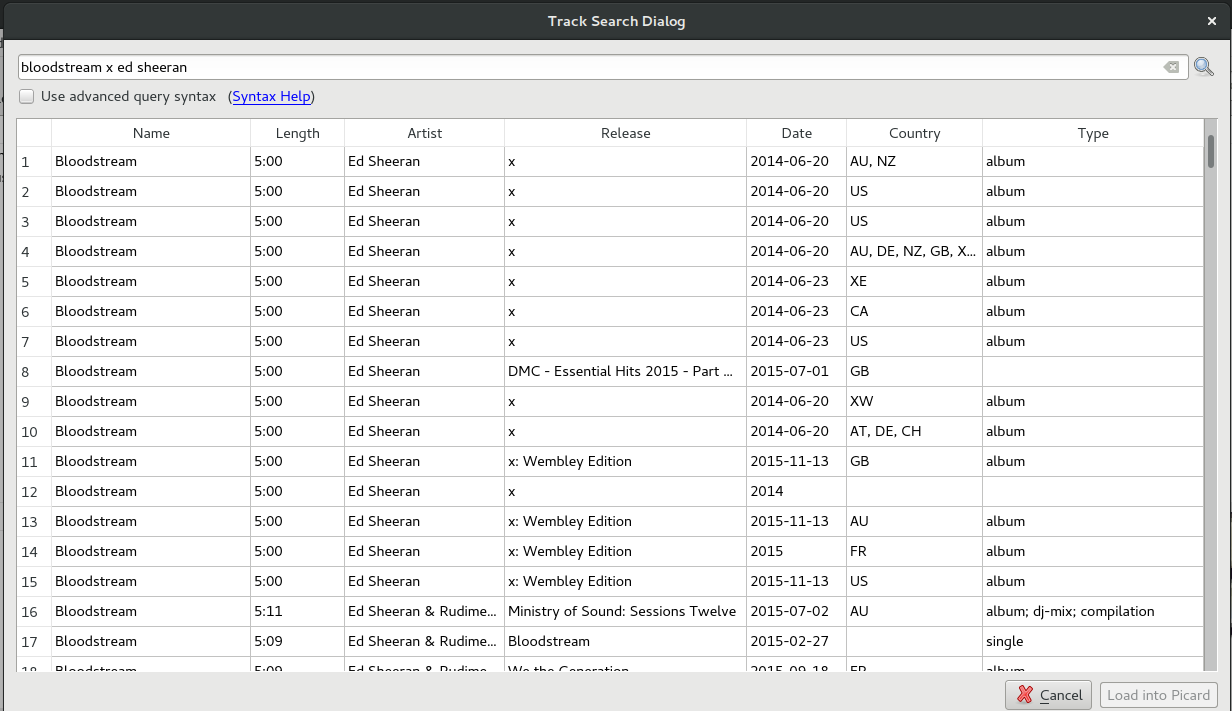
  1. Track Search Dialog — Searches for tracks and allows optionally loading corresponding album back into Picard. track_dialog
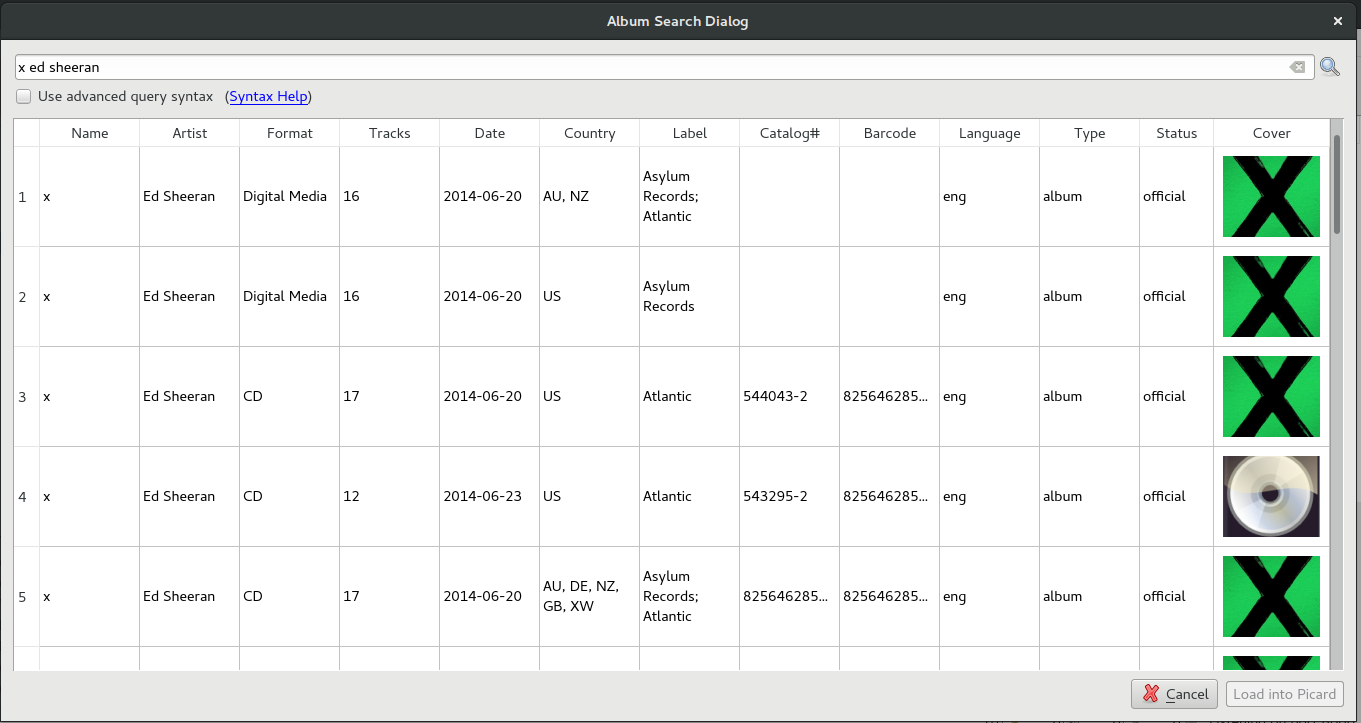
  2. Album Search Dialog — Searches albums and optionally allows loading the selected one into Picard. Screenshot from 2016-08-15 17-08-09
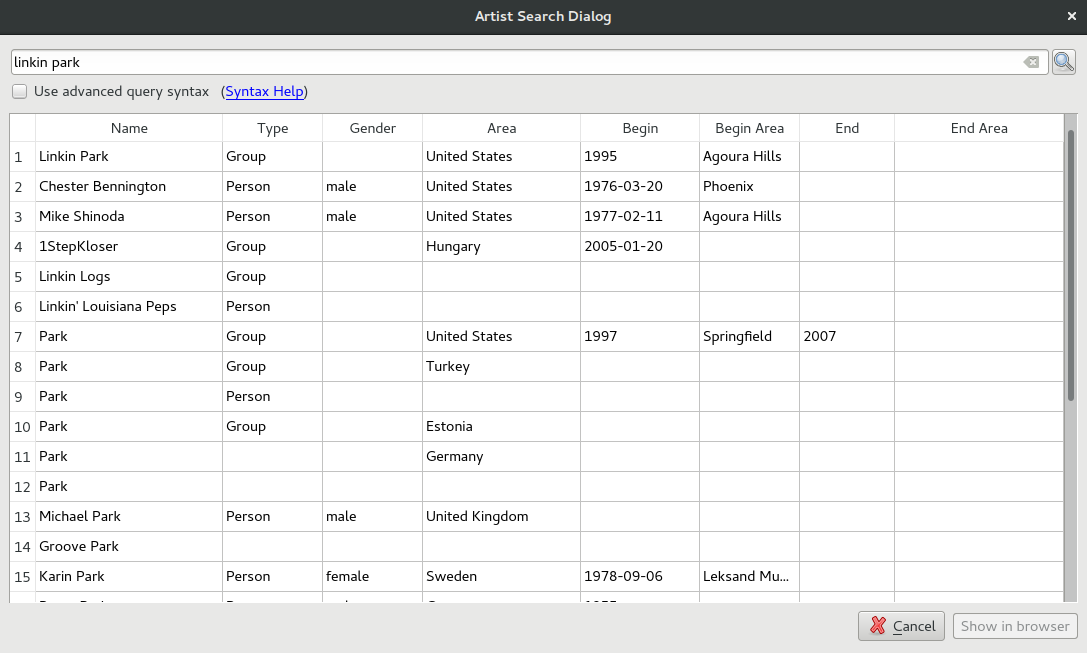
  3. Artist Search Dialog —  Displays basic information about the artists. To get more information about the selected artist, there’s an option to lookup him/her in browser. Screenshot from 2016-08-20 15-55-42

Searching similar tracks/releases

This is another important part of the project. Sometimes Picard fails to auto tag a file (or a cluster), or incorrectly tag it. These dialogs may prove useful here. To get expected data, right click on the file (should be in “Unmatched Files” cluster), and select “Search for similar tracks…”. The track search dialog would pop up, and expected release can be looked up there. Same procedure is for searching clusters.

Links to my work

Each PR is based on the previous one. A new dialog in each, plus some improvements to existing dialog. For trying the dialog, clone the artist search branch, until it gets merged into master. It has the most recent changes.

Note: To use these dialog for searching, an option in User Interface setting about built-in search needs to be enabled.

Conclusion

It was quite fun doing this project. Thanks to Michael Wiencek (mentor) for the guidance and leniency :). Also the Picard team for the reviews. I look forward to contribute more to Picard, now that I’ve a better understanding of the code. Also for another Summer of Code.

BookBrainz GSoC Gamification/Achievement System

Hi guys, I’m Max (AKA QuoraUK), a university student working with BookBrainz as part of Google Summer of Code. My project this summer has been to build a new gamification system, that introduces rewards for BookBrainz users and recognises their achievements. Here I will explain the system and the features I’ve implemented.

Overview

My original specification for the gamification system is here. To summarise, the idea behind gamification is to add game-like elements to the site in order to make it more engaging for users. The plan for the gamification of BookBrainz was:

  • Add badges and titles for users to earn on the BookBrainz site
  • Allow users to display badges and titles on their profile page
  • Encourage regular and high quality content

To implement this plan we have added 12 achievement tracks – once an achievement track is completed a title is unlocked. The artwork for the badges is currently “programmer art” and we are very open to other people designing replacements for them. This could be a part of this year’s Google Code-In. The achievements that will be available on launch are:

revisioncreator
Revisionist: Perform (1, 50, 250) Revision(s); Creator Creator: Create (1, 10, 100) Creator(s)
limitedpublisher
Limited Edition: Create (1, 10, 100) Edition(s); Publisher: Create (1, 10, 100) Publication(s)
pubcreatworker
Publisher Creator: Create (1, 10, 100) Publisher(s); Worker Bee: Create (1, 10, 100) Work(s)
runnerexplorer
Sprinter: Create 10 revisions in an hour; Fun Runner: Create a revision a day for a week; Marathoner: Create a revision a day for 30 days; Explorer: View (10, 100, 1000) Entities
timetrack
Time Traveller: Create an edition before it is released; Hot Off the Press: Create an edition within a week of release

All of these are unit tested and have unique badges for each tier on the track. If you would have already unlocked these achievements before the system was launched, you will earn them with your next revision/creation. Badge templates are available for developers to introduce new badges and adding achievements can be as simple as making a badge and adding a few lines of code.

Profile Page

profilednd
Profile Page, Drag and drop badge selector

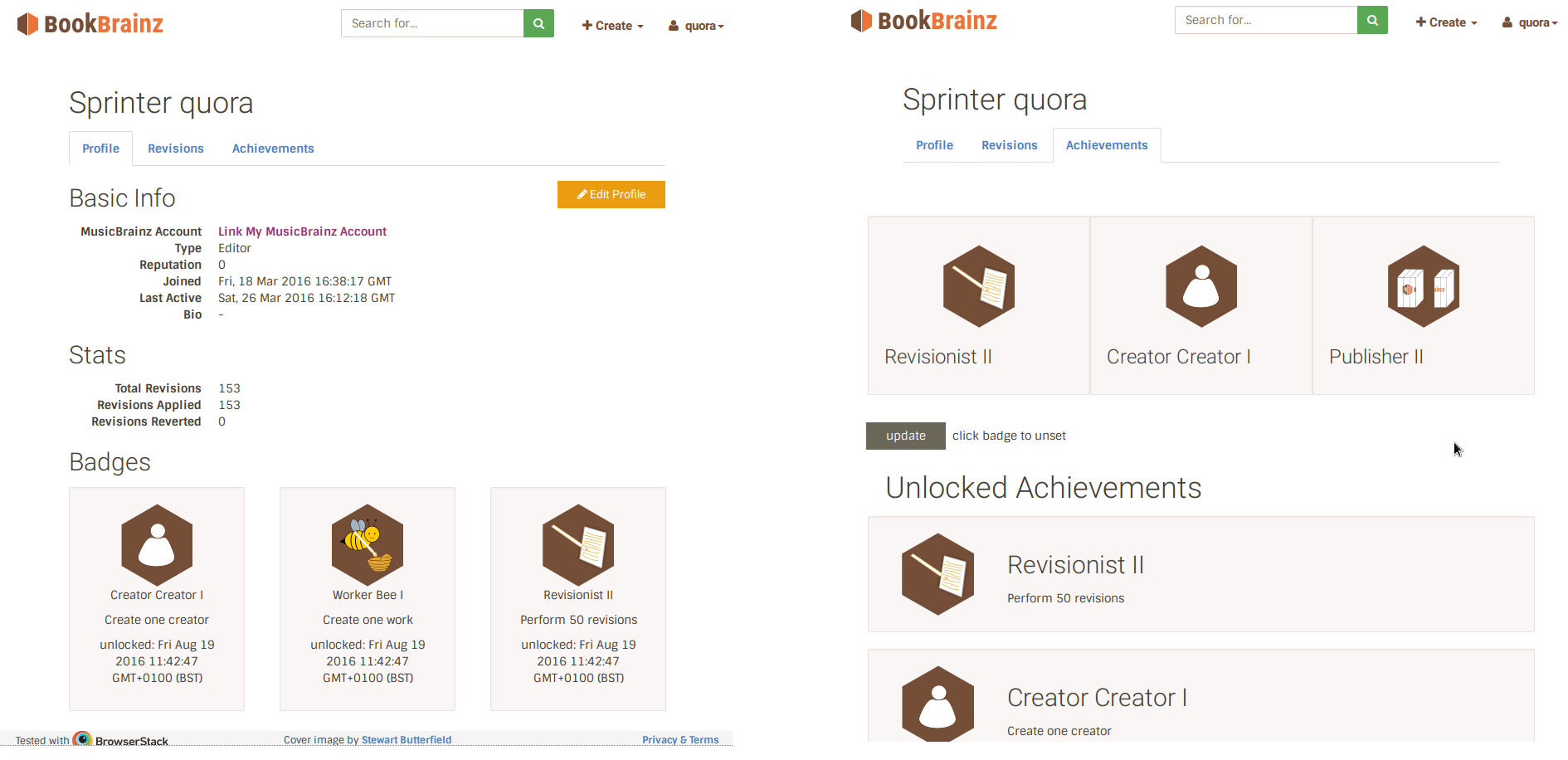
The gamification system also brings some changes to the profile page. There is now a badge box which can contain your three favorite badges. Additionally, your selected title is shown next to your username. You can select your favorite badges in the new achievements menu on the profile, then drag and drop your favorites into the boxes. Titles can be selected by going to Edit Profile, and selecting them from the drop down menu.

Other Areas

2016-08-20_16-12-21
Achievement Alert

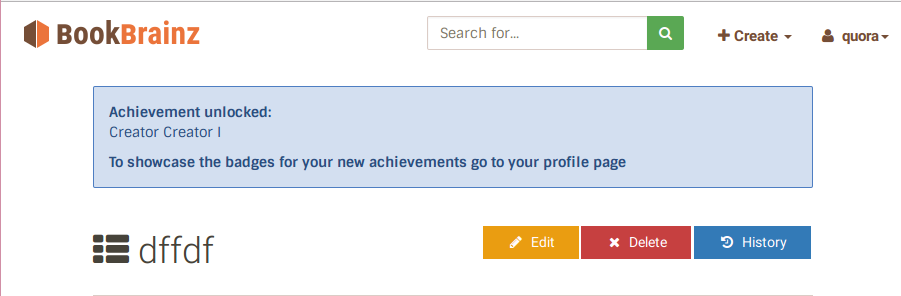
On creation of an entity or revision you will now see an alert if an achievement is unlocked. This will prompt you to go to your profile page and set the ones you want to display. Usernames in other areas of the site can be hovered over in order to see the title they have set.

Demonstration

Here is a demonstration video I’ve made for the system:
[youtube https://www.youtube.com/watch?v=XEZROTq1lY0]
Continue reading “BookBrainz GSoC Gamification/Achievement System”

GSoC 2016 students and projects

Google announced the final list of Google Summer of Code 2016 students and their projects yesterday. The list of MetaBrainz’ projects can be seen at our page on the GSoC site, but just for good measure, here’s the rundown:

MusicBrainz
Jeff Weeks (weeksio) returns to finish up the SOLR search server. We’re really hoping that this will be the end of our current search server woes. He will be mentored by the German duo of Ulrich Klauer (chirlu) and Rob Kaye (ruaok).
MusicBrainz Picard
Rahul Raturi (rahulr) will be working on improving searching MusicBrainz from within Picard, mentored by MusicBrainz’ senior developer Michael Wiencek (bitmap).
BookBrainz
Max Prettyjohns (QuoraUK) is going to try and take on adding gamification to our fledgling book/literature database. He will be supervised by the BookBrainz project leads and lead developers Ben Ockmore (LordSputnik) and Sean Burke (Leftmost).
ListenBrainz
Pinkesh Badjatiya (armalcolite) has pledged to tackle adding a much requested feature for our youngest project: implementing a Last.FM compatible submission API. Robert Kaye (ruaok) will be the one guiding him along.
AcousticBrainz
Daniele Scarano (hellska) will be spending the summer writing a toolkit for creating datasets, which should help researchers using AcousticBrainz. He will be mentored by MetaBrainz software engineer Roman Tsukanov (Gentlecat).
Kartik Gupta (kartikgupta0909) has set out to create an offline client for computing AcousticBrainz dataset evaluations. Alastair Porter (alastairp), the AcousticBrainz project lead, will be their mentor.
Goran Cetusic (cetko), our final student of this year, will be exploring how AcousticBrainz data can be utilised within Google’s BigQuery storage under the guidance of Alastair Porter.

Congratulations and good luck to all our students! We’re looking forwards to following your progress over the summer and see what you end up with. 🙂

For all the students that applied but did not get accepted: we appreciate your applications, and even if you did not make the cut this year, we hope that you will stick around and apply with us again next year when we know you better – and you know us better.

For now, let the community bonding… begin! 🙌

MetaBrainz & GSoC 2016

Google announced who the chosen organisations for their Google Summer of Code were earlier tonight… And MetaBrainz was amongst them for yet another year (our 10th!)!

If you’re a prospective GSoC student who is hoping to apply with MetaBrainz this year, be sure to check out our guide to getting started and our currently suggested projects – but also note that we’d love for you to come up with your own suggestion! You may also want to take a look at the application template, which contains suggestions about
some of the things you should do and know before submitting your proposal.

For those of you who are already members of our community, you’re also welcome to add ideas to the suggestions page, and please be gentle when the GSoC hopefuls come along. 🙂

That’s really all for now, but expect to hear more about GSoC and our participation over the coming months!

Wrapping up Google Code-in 2015

The Google Code-in Google Code‐in is pretty much over for this time, and we’ve had a blast in our first year with the competition in MetaBrainz with a total of 116 students completing tasks. In the end we had to pick five finalists from these, and two of these as our grand prize winners getting a trip to the Googleplex in June. It was a really, really tough decision, as we have had an amazing roster of students for our first year. In the end we picked Ohm Patel (US) and Caroline Gschwend (US) as our grand prize winners, closely followed by Stanisław Szcześniak (Poland), Divya Prakash Mittal (India), and Nurul Ariessa Norramli (Malaysia). Congratulations and thank you to all of you, as well as all our other students! We’ve been very excited to work with you and look forwards to seeing you again before, during, and after coming Google Code-ins as well! 🙂

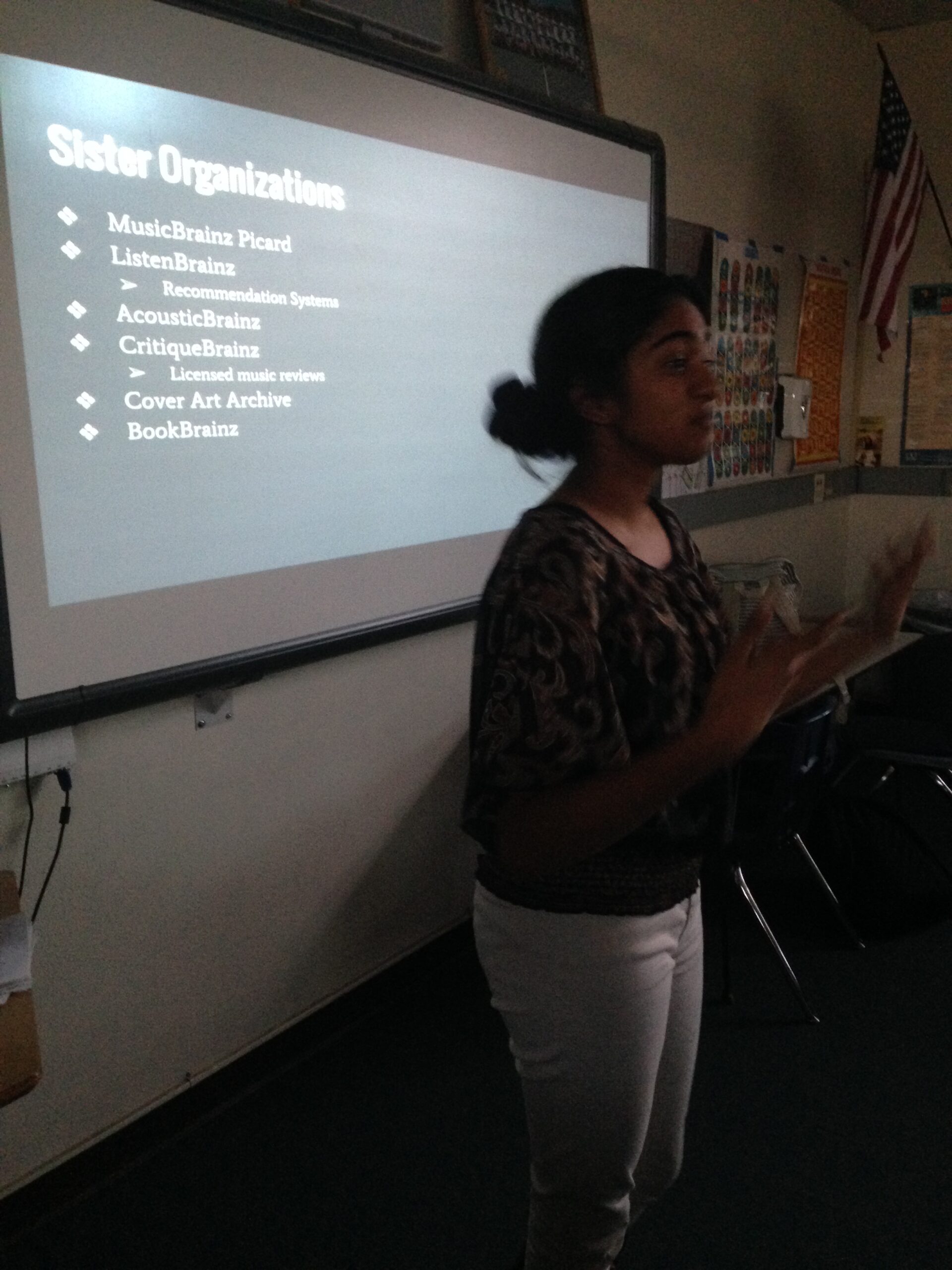
Rayna Kanapuram MusicBrainz presentation
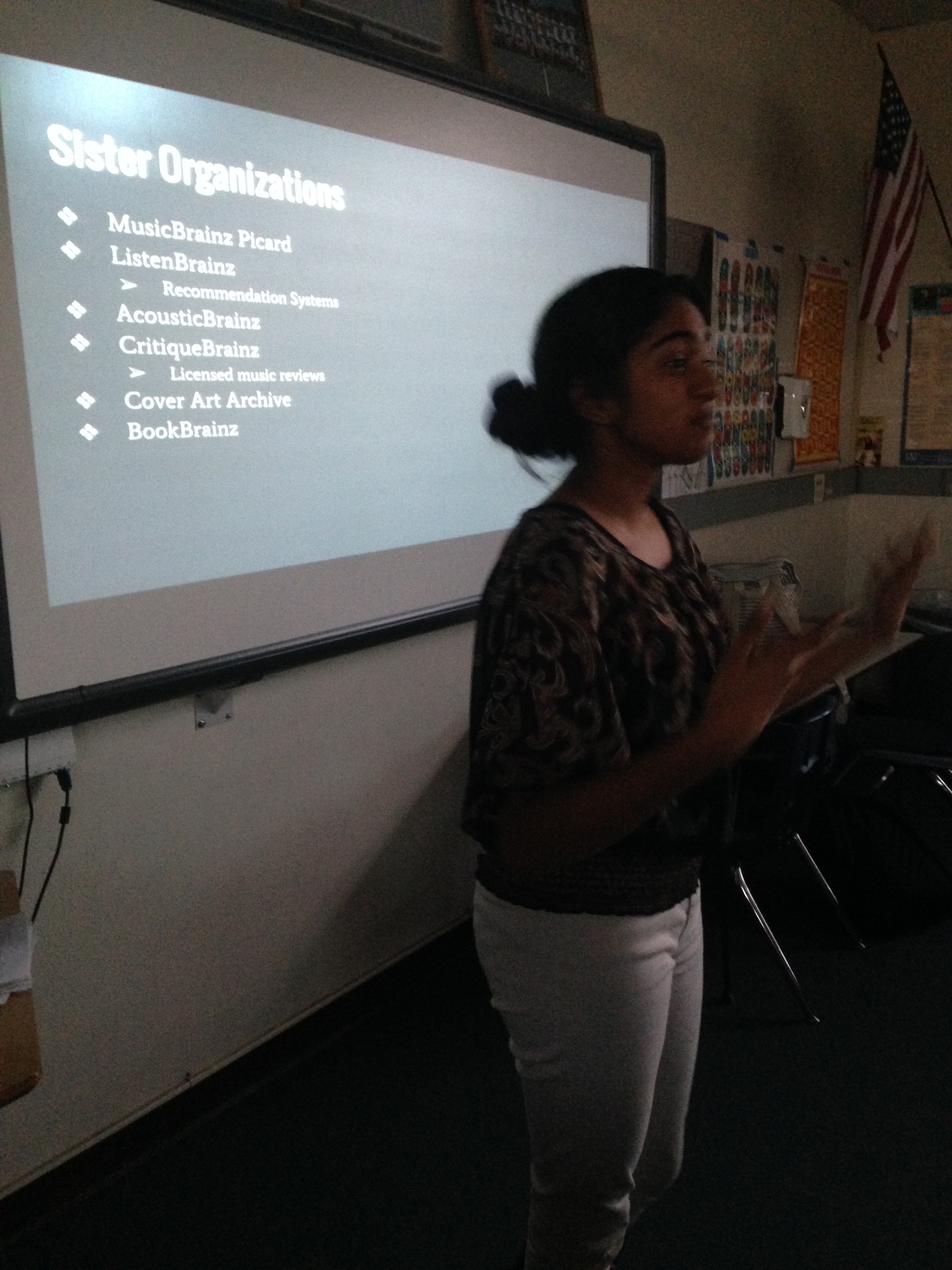
Indian student Rayne presenting MusicBrainz to her classmates.

In all we had 275 tasks completed during the Google Code-in. These tasks were divided among the various MetaBrainz projects as well as a few for beets. We ended up having 29 tasks done for BookBrainz, 124(!) tasks for CritiqueBrainz, 95 tasks for MusicBrainz, 1 task for Cover Art Archive, 6 tasks for MusicBrainz Picard, 3 tasks for beets, and 17 generic or MetaBrainz related tasks.

Some examples of the tasks that were done include:

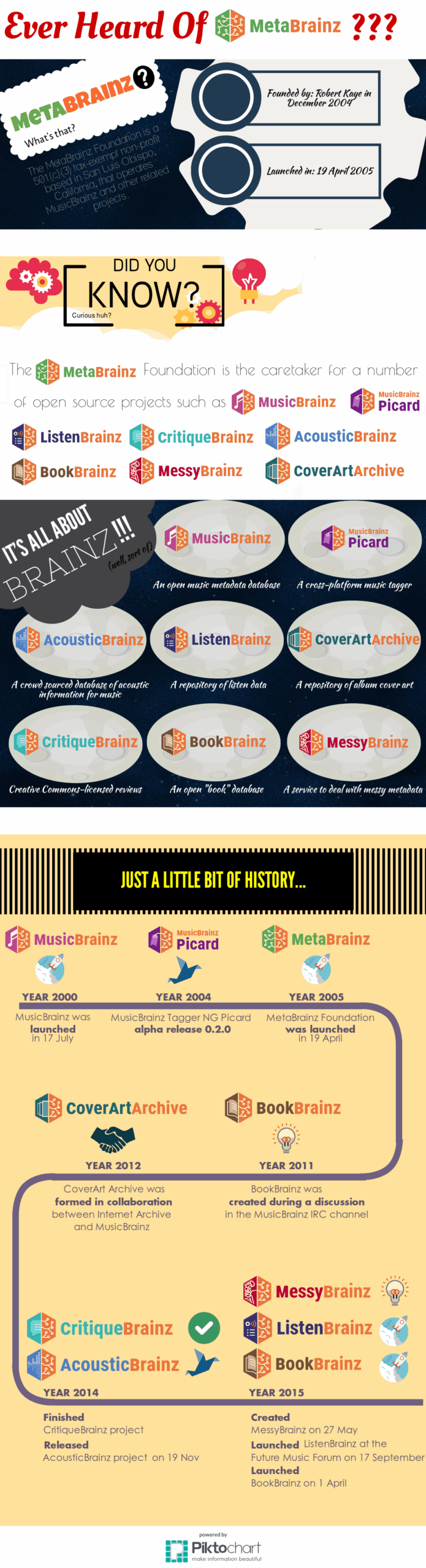
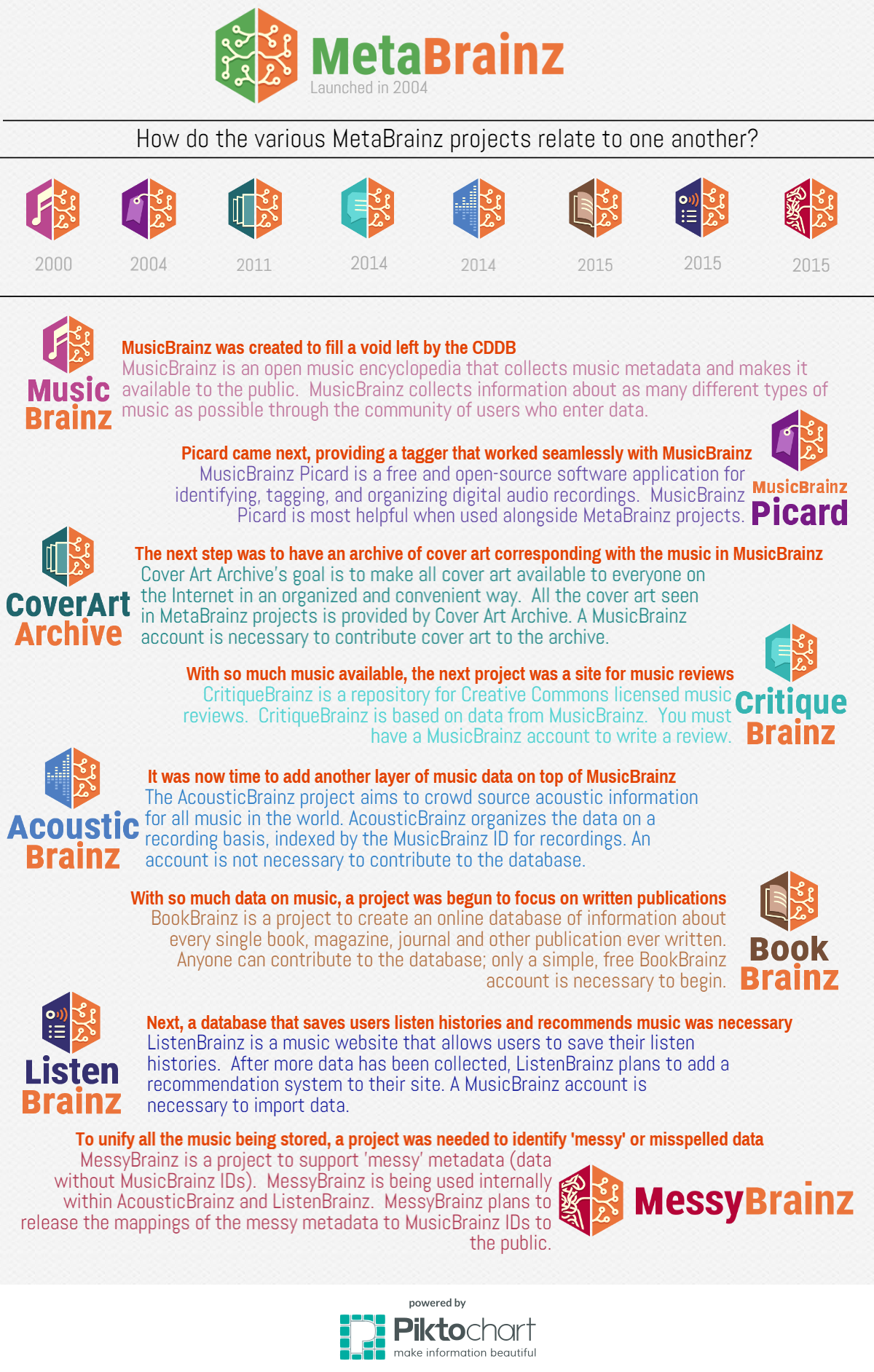
Ariessa MetaBrainz infographic
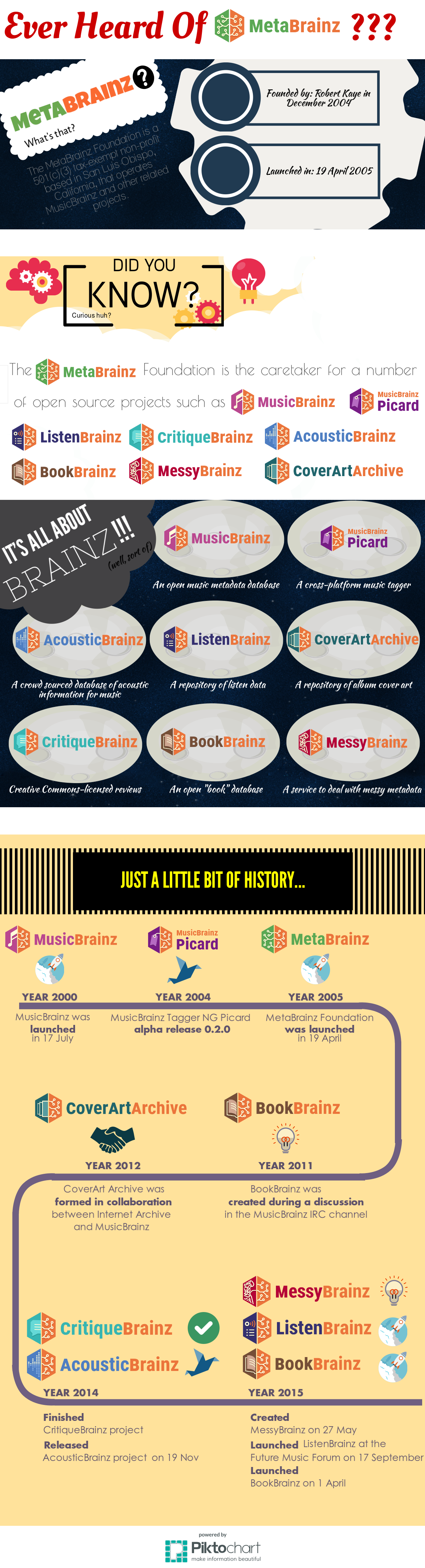
Finalist Nurul Ariessa Norramli’s MetaBrainz infographic.

In all, I’m really darn happy with the outcome of this Google Code-in and how some of our finalists continue to be active on IRC and help out. Stanisław is continuing work on BookBrainz, including having started writing a Python library for BB’s API/web service, and Caroline is currently working on a new icon set for the MusicBrainz.org redesign that can currently be seen at beta.MusicBrainz.org.

Again, congratulations to our winners and finalists, and THANK YOU! to all of the students having worked on tasks for MetaBrainz. It’s really been an amazing ride and we’re definitely looking forward to our next foray into Google Code-in!

One month of Google Code-in

So today it is a month ago since the Google Code-in competition started and 18 days until it is ending. I wanted to take this opportunity to talk a bit about some of the things that have happened so far and where we’re at.

Google Code‐inSince December 7th when Google Code-in started, we have been in touch with 107 students on the Google Code-in site, of which 70 have completed at least one task and thus earned a digital certificate from Google. 11 students have so far earned themselves a t-shirt from Google by completing 3 or more tasks. The student with the highest number of completed tasks right now sits at 17 tasks, followed by one at 16 and another at 15 completed tasks. The student with the 10th most tasks completed has 3 tasks to their name.

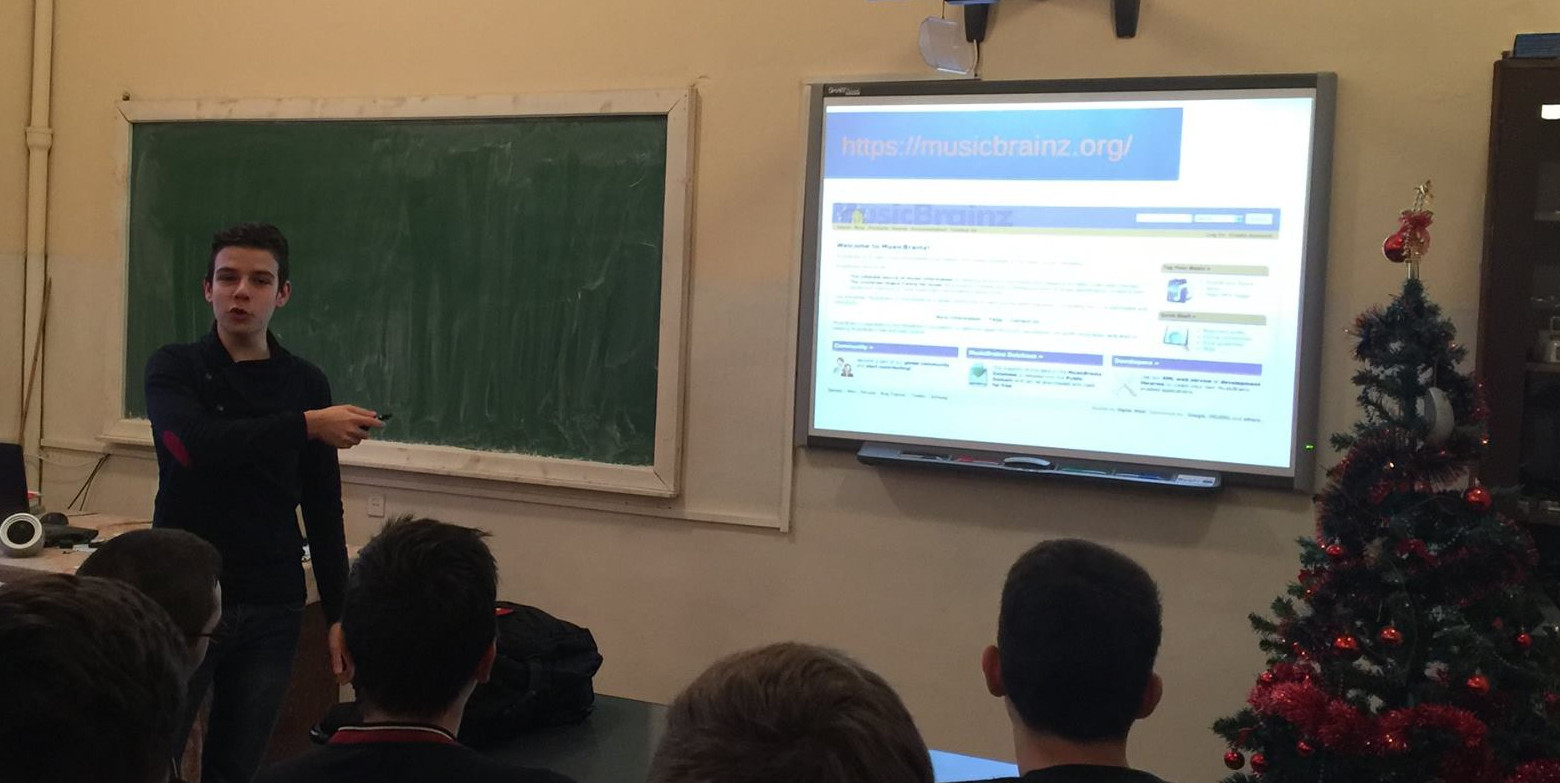
Stanisław Szcześniak presenting about MusicBrainz
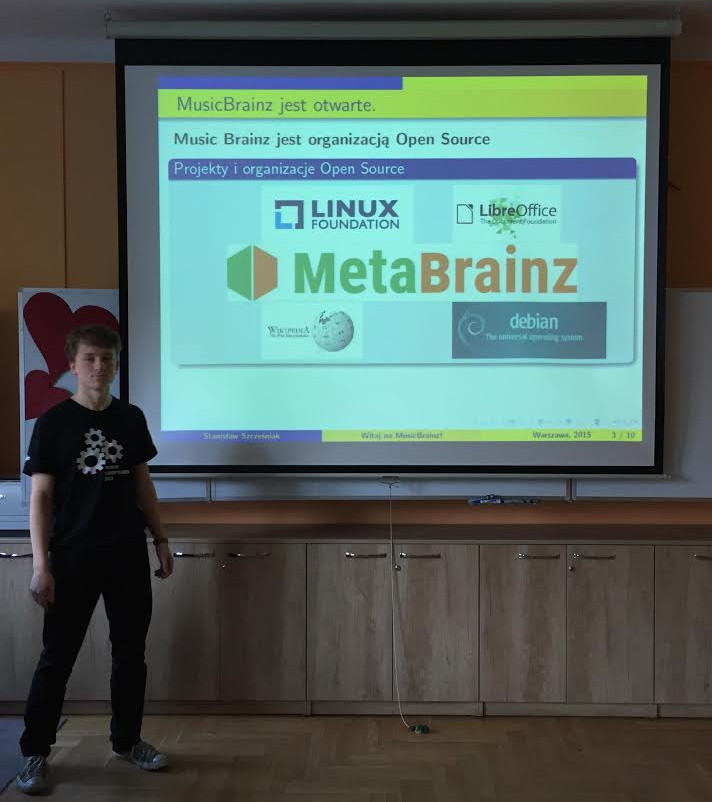
Stanisław Szcześniak, GCI student from Poland, presenting about MusicBrainz.
We have had 7 students do presentations on MusicBrainz in at least India, Romania, England, and Poland; about 50 reviews written for CritiqueBrainz with a few more in progress; a couple of MusicBrainz how to’s written for the wiki; one video tutorial made (which hasn’t been uploaded yet); a bunch of tests written for BookBrainz; updated and have had made a bunch of icons/logos in various places; a bunch of code patches and tests written for almost all our projects, as well as for beets (a 3rd party music file tagger and organiser heavily using MB data).

We have also had to report 3 students for plagiarising leading to their disqualification. 🙁 However, compared to the amount of work and number of students, I think it’s a decently small number.

Overall, I am (still!) really excited about MetaBrainz finally being a part of Google Code-in, and I definitely think the lack of sleep the first week and newbie questions on IRC and on the GCI tasks are worth it. We’re getting some great stuff done, that we may not have gotten around to in any reasonable time ourselves, and we get to help all these students learn about programming, open source, open data, licenses, and a bunch of other things. I’m happy and I’m not looking forward to picking only 5 finalists and only 2 winners. There are definitely more than that I would personally like to see in both categories. 🙂

Have you had any experiences with or thoughts on our Google Code-in participation so far? Please do share them with us in the comments!

Google Code-in announcement! – and call to arms

As many of our loyal blog readers will know, the MetaBrainz Foundation has been part of the Google Summer of Code for several years. This year we’re going to expand into the realm of Google Code‐in!

Google Code‐inGoogle Code‐in, or GCI, is a program aimed at pre-university students aged 13–17. Unlike the Summer of Code (GSoC), the students will have a large number of smaller tasks to work on, instead of working on one large/huge task for the duration of the summer. It is set up as a competition and the students who do the most work will be eligible to win some Google prizes.

But what does this have to do with us? I’ll tell you what! We were accepted in this year’s Code-in! Over the last few weeks, I and a couple of other people (mostly on IRC) have been preparing for the GCI, but that does not mean we’re done yet – we can still very much use more hands. The competition starts on December 7th—that’s Monday next week! This means that we will have a flood of young people come into #musicbrainz and #metabrainz on IRC as well as possibly the forums. Please be courteous and patient; these young people will hopefully stick around Music– and MetaBrainz for long after the GCI and become full‐blown members of the community, but they need some incubation time. (Also, if you only sometimes frequent IRC, next week in particular would be a lovely time to have “all hands on deck”. Doubly so if you’re in the far eastern hemisphere as students will be coming from all different time zones and regions, and we only have a couple of East Asian and Australasian people in the IRC rooms.)

We are also continually looking for task suggestions. They can be for or from pretty much anything related to any MetaBrainz projects (we will have a number of *Brainz related tasks for beets for example), so let your creative juices flow and let us know what (small) things you would like some of these students to work on. The wikipage has some more information about what kind of tasks are acceptable. Keep in mind that they should generally be doable within 3–6 hours, but if you’re in doubt, feel free to poke one of our GCI mentors and ask.

Speaking of mentors, we could really use more mentors who are familiar with our various code bases. If you think that’s you, please, please, please poke me (Freso) on IRC and we can get things sorted. Of course, even if you don’t think you’ll be able to be a dedicated mentor, just hanging around IRC and helping students will also be a huge help and relieve the mentors somewhat to spend time on reviewing submitted work, entering additional tasks, etc.

I’m personally, and I know others are too, really excited about this. It’s a great opportunity to hopefully get a lot of low‐hanging fruit picked off as well as recruiting some new (hopefully) long‐term community members and contributors. However, it is also our first year in this program, so none of us really know what we’ve signed up for. It’s an adventure! And I hope you will be joining us. 😉

PS. If you know any pre-university students aged 13–17, tell them about the program and maybe use this as a way to lure them into the Brainzverse! 😄